
What Should Buyers Check When Sourcing Retractable Window Screens?
Start with the cassette mechanism, mesh specification, installed dimensions and the window's opening direction. A retractable window screen can look similar across suppliers while differing in spring control, guide-rail fit, sealing and spare-part compatibility. For a bulk order, these details matter more than a catalogue photograph.
Window distributors, builders and OEM buyers should request a model-specific drawing and sample before committing to a size assortment or private-label programme.
Which Three Parts Decide Whether the Screen Will Fit and Work?
Cassette and spring
Check retraction speed, end stops, handle control and whether the mechanism is accessible for servicing.
Mesh and seals
Confirm fiberglass mesh construction, side retention and brush seals around the moving pull bar.
Window interface
Measure available mounting depth, clearance from hardware and the actual position of the window sash.
A good sample test combines all three: operate the screen in the intended frame, then inspect the mesh edges and closing contact.
How Should a Roll-Up Window Screen Retract?
A typical vertical retractable window screen stores fiberglass mesh around a tube inside an aluminium cassette. The pull bar moves along guide rails until it reaches its closing position. When released, the retraction mechanism winds the mesh back into the housing.
Check grip position and effort at different heights.
Observe whether both edges stay seated in the side rails.
Inspect contact with the lower receiving profile and seals.
Check whether the bar rises without a hard impact.
Flyziran lists an adjustable cushion or brake arrangement for its SO-01-201V product. That is a model-specific feature, not proof that every roll-up screen includes speed control. Ask for a demonstration of the proposed mechanism.
What Should Buyers Inspect in the Actual Assembly?
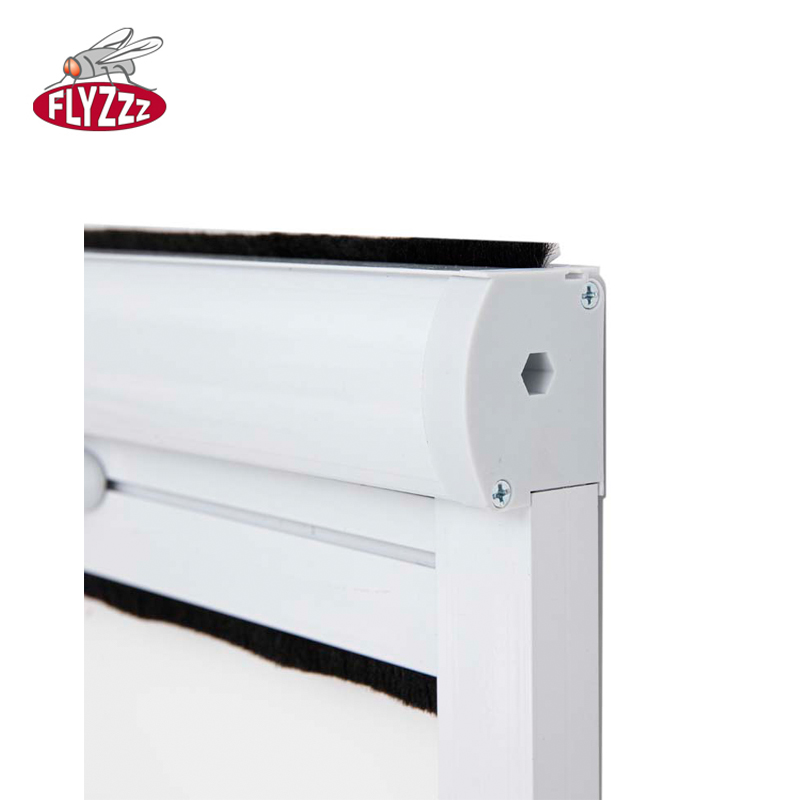
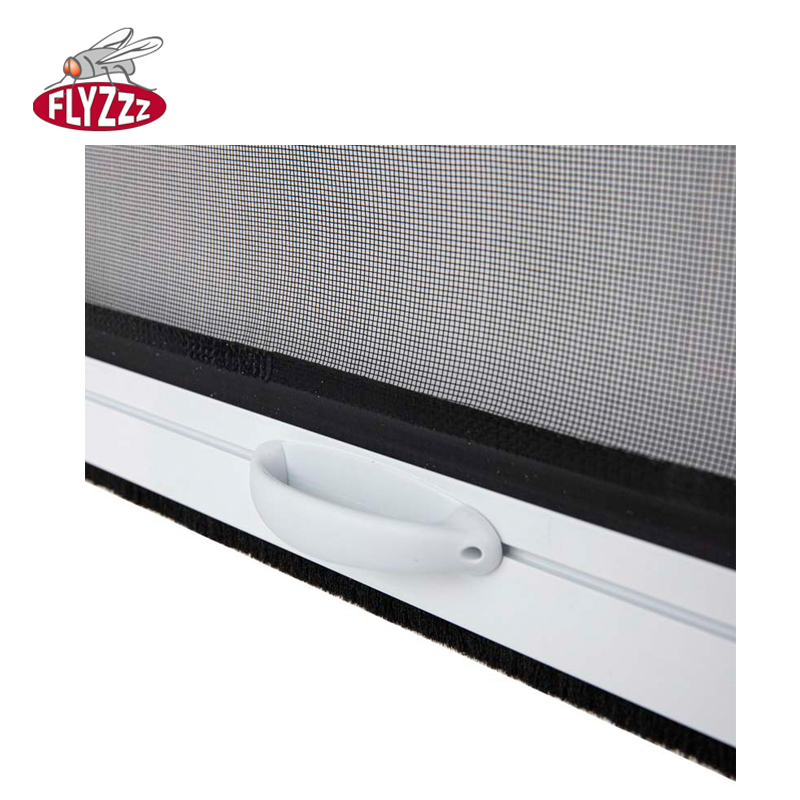
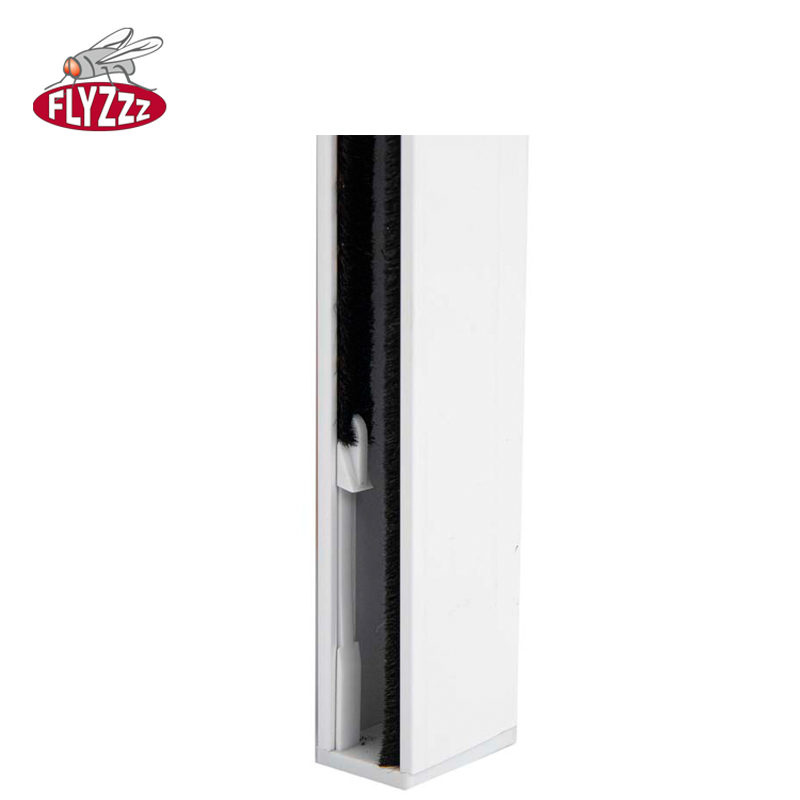
Photographs show components from Flyziran's Roll Up Retractable Insect Mosquito Screen Window Net listing. Ask for current production photographs if specifying a revised model.
Which Model Dimensions Can Be Checked Before Quotation?
Two current product listings show different size limits. Keep the product codes separate in your technical file and confirm the actual orderable dimensions for each configuration.
| Item | SO-01-161V | SO-01-201V |
|---|---|---|
| Screen format | Roll-up retractable insect screen window | Roll-up retractable insect screen window |
| Materials listed | Aluminium profiles, nylon accessories, fiberglass mesh | Aluminium profiles, nylon accessories, fiberglass mesh |
| Listed maximum size | 150 cm W × 220 cm H | 160 cm W × 250 cm H |
| Example sizes on listing | 80 × 160; 100 × 160; 120 × 170; 140 × 170; 160 × 170 cm | 80 × 160; 100 × 160; 120 × 170; 140 × 170; 160 × 170 cm |
| Finish options listed | White, brown, black, ivory and other colours | White, brown, black, ivory and other colours |
| Retraction brake | Not specified on this listing | Adjustable cushion/brake described |
| Supply formats | Fixed-size or semi-finished materials | Fixed-size or semi-finished materials |
The SO-01-161V listing includes a 160 cm nominal example width alongside a 150 cm stated maximum width. This inconsistency should be resolved with a current drawing and written size confirmation before an order is placed. Neither figure should be treated as the universal maximum across Flyziran's window-screen range.
What Mesh Details Matter Beyond the Material Name?
Fiberglass mesh is common in roll-up insect screens, but the term alone is not a purchase specification. Specify mesh count, yarn diameter or opening size, coating, colour and attachment method. For darker mesh, check the visibility required by the customer as well as the appearance when rolled into the cassette.
| Mesh or sealing item | What to examine on a sample | What to request |
|---|---|---|
| Mesh openings | Even weaving without broken strands | Mesh count or measured opening dimensions |
| Surface coating | No tackiness, flakes or visible edge damage after rolling | Material/coating specification and care instructions |
| Side retention | Mesh remains aligned in guide rails during movement | Guide profile drawing and replacement-parts list |
| Pull-bar brush | Consistent contact at the closing edge | Brush-strip material and section details |
| Mesh replacement | Service access without damaging the cassette | Replacement procedure and spare-mesh availability |
Flyziran's Insect Screen Mesh category lists 16×18 and 15×17 mesh among its general fiberglass products. Those figures should not automatically be assigned to the retractable screen model. Confirm the mesh actually installed in the ordered SKU.
Will the Cassette Fit the Existing Window?
Measure the clear width and height in at least three positions. Note whether the frame is square and whether the cassette will be face-mounted or installed within the reveal. A large nominal window does not necessarily provide enough fixing space for a cassette and two rails.
| Window condition | Potential conflict | Check before approval |
|---|---|---|
| Inward-opening casement | Sash or handle may strike the cassette | Full swing path and handle projection |
| Outward-opening casement | Exterior fixing may affect access or weather exposure | Safe installation side and fixing substrate |
| Sliding window | Overlap with sash track or lock | Available flat frame area and operating clearance |
| Tilt-and-turn window | Both opening positions require clearance | Tilt arc and turn operation with screen fitted |
| Uneven renovation opening | Guide rails may twist or leave sealing gaps | Smallest clear dimension, diagonals and fixing shims |
For existing buildings, photographs of the closed window and its fully open position are often as useful as nominal dimensions. Include the sill detail so the lower closing profile can be specified correctly.
Which Customization Decisions Should Be Made Early?
Determine whether the order will ship as complete retail-ready screen kits or semi-finished profiles and components for local cutting and assembly. The two models require different packing, instructions and quality checks.
- Finished kits: finalize the size mix, frame colours, hardware pack, carton marking and installation guide.
- Semi-finished supply: specify profile lengths, mesh roll dimensions, end caps, pull bars, brush seals and assembly tolerances.
- Private label: approve packaging artwork, product code, barcode placement and spare-part identification before production.
- Project supply: provide a window schedule and identify which rooms require special installation details or non-standard sizes.
Custom colours and dimensions are subject to the chosen extrusion, mechanism and order quantity. Confirm any tooling requirement before promising a customer-specific profile design.
How Should Buyers Test a Sample Before Placing a Bulk Order?
A drawing can confirm geometry, but it cannot show whether the pull bar retracts at a comfortable speed or whether the mesh remains aligned after repeated use. Test the sample in a representative installation.
| Inspection | Acceptance question | Evidence to keep |
|---|---|---|
| Dimensions | Do finished external sizes match the agreed drawing? | Measured sample record |
| Retraction | Does the pull bar move smoothly without jamming or hard impact? | Operating video and test observations |
| Sealing | Are the side gaps and closing-edge contact acceptable? | Installed close-up photographs |
| Mesh surface | Are weave, coating and tension consistent? | Approved mesh sample and specification |
| Finish | Is the colour and visible coating acceptable? | Signed colour chip or approved sample |
| Packing | Are profiles, mesh and fittings protected in transit? | Pack-out photos and carton test requirements |
| Documentation | Are the installation instructions and parts list complete? | Released documents with revision number |
If the project calls for repeated-cycle or environmental performance, agree the test conditions and acceptance criteria in writing. A general statement about factory quality cannot replace results for the selected assembly.
When Should a Buyer Choose a Window Roll-Up Instead of Another System?
| Format | Typical selection reason | Main trade-off |
|---|---|---|
| Retractable window screen | Mesh can be stored inside a cassette between uses | Mechanism and rail alignment require attention |
| Fixed-frame insect screen | Simple assembly for openings needing constant coverage | Frame occupies the opening until removed |
| Sliding window screen | Works with selected sliding-window layouts | Panel overlap and track geometry affect fit |
| Retractable screen door | Designed around full-height pedestrian openings | Door dimensions and usage differ from window kits |
For a connected product range, compare the Retractable Screen Door category. The frame, spring and cassette on a door assembly should not be assumed interchangeable with those of a window product.
Send a Window Schedule for an Accurate RFQ
Request a model-specific quotation
Share the opening schedule, installation method and supply format. Flyziran can review the appropriate roll-up screen assembly, sample requirements and bulk packing arrangement.
Contact Flyziran- Country, window type and opening direction
- Width × height schedule with quantities by size
- Face-mount or reveal-mount preference
- Frame colour, fiberglass mesh and sealing details
- Finished kits or semi-finished OEM materials
- Target quantity, packaging and delivery location
FAQ: Retractable Window Screen Procurement
A retractable screen winds mesh into a cassette when not required. A fixed screen holds its mesh in a stationary frame. The choice depends on access, cleaning and the intended window opening.
Flyziran lists fixed-size and semi-finished supply options. Custom cutting is possible for appropriate systems, but limits depend on the cassette, spring and guide-rail design. Obtain an approved cutting and assembly drawing.
No. A cushion or brake is described for Flyziran model SO-01-201V, but buyers should confirm the feature for their exact SKU and test the retraction action on a sample.
Provide clear width and height, available mounting depth, frame diagonals, handle clearance, opening direction and sill photos. Also identify whether the screen is to be mounted within or onto the existing frame.
Approve the complete sample, mechanism, finish, mesh specification, finished dimensions, packing list and installation instructions. Record accepted performance checks and spare-part identifiers against the product revision.
Specify the Window System Before Ordering in Volume
Choose the model, confirm clearances and approve a working sample. Send Flyziran your window schedule for a bulk or OEM quotation.
Prepare Your RFQ