Categories
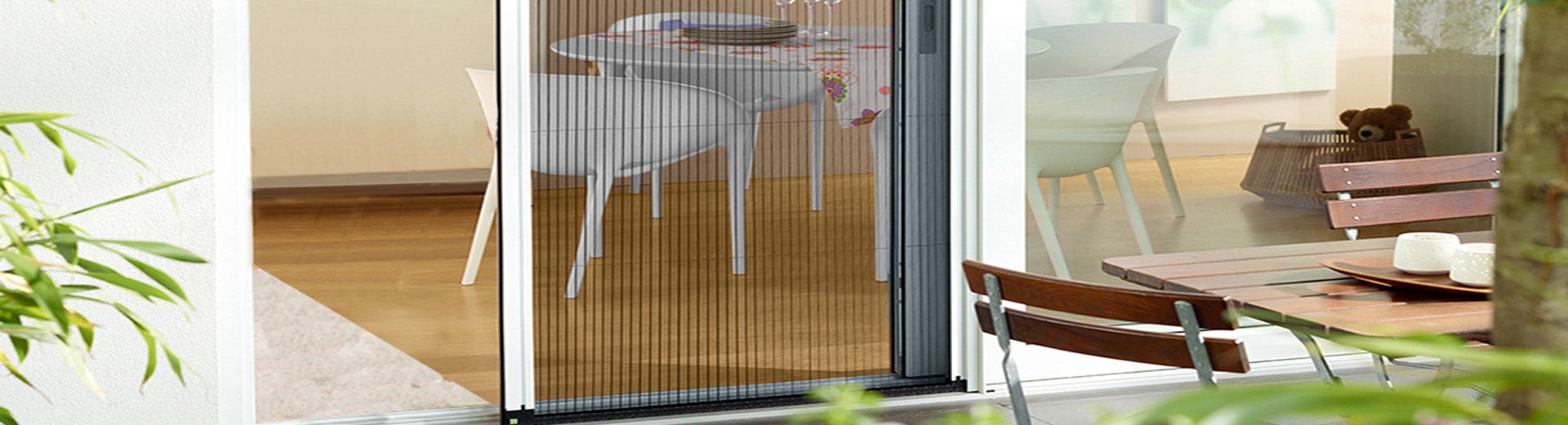
A pleated mesh door is a retractable insect screen system designed to provide insect protection while keeping door openings accessible and visually open. For residential developments, hotels, apartments and commercial projects, its main engineering advantage is the ability to cover relatively wide openings while folding into a compact side stack when not in use.
For distributors and project buyers, the decision is not simply about whether a screen can stop insects. Product dimensions, mesh construction, aluminium profiles, operating method, installation conditions, colour options and repeat-order consistency all affect the total procurement value.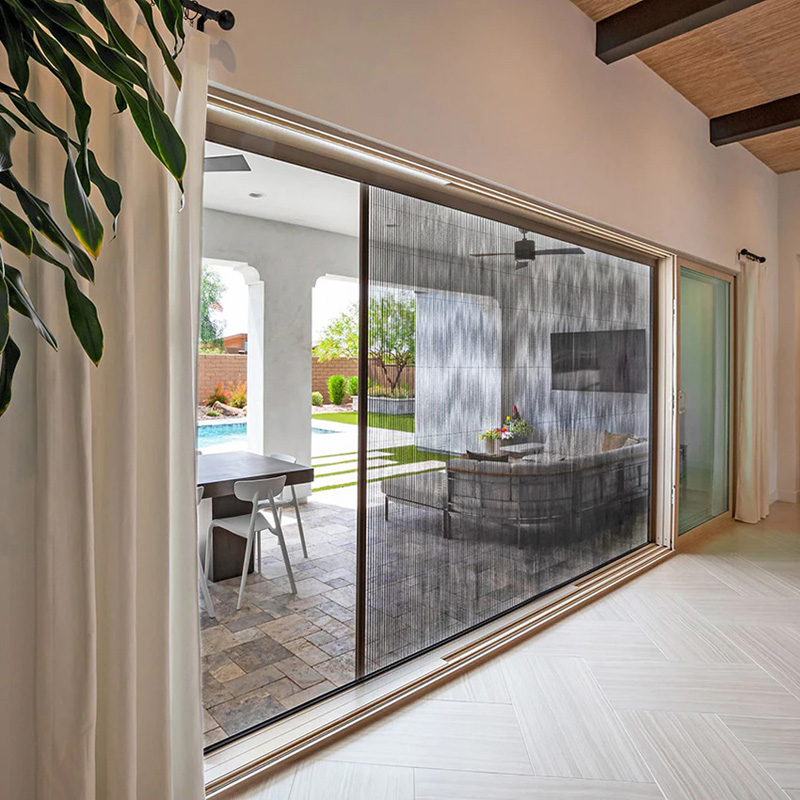
A pleated mesh door uses a folded insect mesh rather than a flat fixed screen panel. The mesh is formed into repeated pleats and connected to an aluminium frame or operating system.
When the screen is closed, the pleated mesh extends across the door opening. When opened, the mesh folds back into a compact stack at the side.
This structure is different from a conventional hinged insect screen door.
| Feature | Pleated Mesh Door | Hinged Screen Door | Fixed Screen Panel |
|---|---|---|---|
| Opening mechanism | Folding / retractable | Swinging | Fixed |
| Storage space | Compact | Requires swing clearance | Permanent |
| Large openings | Suitable | More restrictive | Suitable |
| Access through opening | Full opening when retracted | Limited by door panel | Screen must be removed |
| Balcony applications | Suitable | Application dependent | Limited |
| Custom dimensions | Available | Available | Available |
| B2B project applications | High | Medium | Medium |
The key difference is how the mesh occupies space during operation. A pleated system moves with the opening rather than requiring a rigid screen panel to swing outward or inward.
Large patio doors, balcony doors and French-door configurations create a specific problem for insect-screen manufacturers: the screen must cover a relatively large opening without creating an equally large obstruction.
A conventional hinged screen door requires clearance for the screen panel to swing. This can interfere with:
A pleated screen door addresses this issue through lateral folding.
When retracted, the mesh occupies a narrow area along the side of the opening. This makes the configuration particularly useful for projects where usable floor space and unobstructed access are important.
Pleated mesh doors can be used for:
For developers and contractors, the system is particularly relevant when multiple units use similar balcony or patio door configurations.
Price should not be the only procurement criterion.
A screen door with a lower unit price can create additional costs if its dimensions are inconsistent, installation is difficult, packaging is inadequate or replacement components are unavailable.
For B2B procurement, buyers should evaluate at least six technical factors.
The mesh is the primary insect barrier.
Depending on the product configuration and target market, manufacturers may offer different mesh materials and specifications.
Important considerations include:
For projects in regions with strong sunlight or long outdoor exposure, UV resistance should be considered during material selection.
The aluminium frame determines much of the structural stability of the screen system.
For project procurement, buyers should check:
A suitable profile should provide enough rigidity for the specified opening dimensions without adding unnecessary material cost.
A custom pleated screen door should be specified according to the actual door opening.
For project orders, it is useful to prepare a size schedule containing:
| Parameter | Required Information |
|---|---|
| Opening Width | mm |
| Opening Height | mm |
| Installation Position | Inside / Outside / Other |
| Frame Colour | Selected colour |
| Mesh Colour | Selected colour |
| Quantity | Units |
| Application | Residential / Hotel / Commercial |
This information allows the manufacturer to evaluate whether the proposed configuration is appropriate before mass production.
The opening configuration should correspond to the actual door layout.
Depending on the system, options may include single-direction or wider-opening configurations.
For large projects, this should be confirmed before production rather than adjusted during installation.
Installation surfaces should be considered during specification.
Relevant factors include:
A technically suitable pleated mesh door can still perform poorly if the installation condition does not match the product structure.
This factor is often underestimated by project buyers.
A distributor may order several hundred units initially and reorder the same product months later. If profile dimensions, mesh colour or component specifications change between batches, installation and after-sales management become more difficult.
For B2B supply, specification control is therefore as important as the initial product price.
In many cases, yes.
Hotels, apartments and residential developments often contain repeated door openings with similar dimensions. This creates an opportunity to standardise the insect-screen specification across multiple rooms or units.
A standardised procurement specification can include:
Once the specification has been approved, subsequent production can follow the same configuration.
This approach can simplify procurement, installation and replacement management across multi-unit projects.
A project buyer could define a screen-door schedule such as:
| Item | Specification |
|---|---|
| Product | Pleated Mesh Door |
| Application | Apartment Balcony |
| Frame | Aluminium |
| Frame Colour | Black |
| Mesh | Pleated Insect Mesh |
| Opening | Custom Width × Height |
| Quantity | Project Based |
| Packaging | Export Packaging |
| Supply | Factory Direct |
The exact dimensions and component specifications should be confirmed according to the project drawings and manufacturer's production capabilities.
For building-material distributors, customisation can be more valuable than simply offering a large number of standard models.
A distributor may serve several window and door manufacturers with different opening dimensions. A factory capable of producing different sizes and configurations can therefore support a broader product range without requiring the distributor to source from multiple suppliers.
Dimensions
Width and height according to the customer's requirements.
Frame Colours
Common architectural colours such as white, black, brown and bronze can be offered.
Mesh Options
Mesh type and colour can be selected according to market requirements.
Packaging
Packaging can be adapted for wholesale distribution, retail sales or project shipment.
OEM/ODM
Product specifications and branding requirements can be discussed for qualified orders.
For large-volume buyers, the manufacturer affects more than the purchase price.
Direct communication with the factory allows buyers to discuss technical specifications before production, including profile configuration, dimensions, mesh selection and packaging.
This can reduce communication layers between the project team and production team.
Xiamen Weiziran has around 20 years of experience in the manufacturing and export of insect screens, screen doors and related aluminium components. The company supports international distributors, contractors and project-based buyers with factory-direct production.
For recurring orders, the focus should be on maintaining a documented product specification so that future batches remain consistent with the approved sample.
There is no single screen-door system suitable for every opening.
The selection should be based on the door dimensions, available installation space, frequency of operation and project budget.
| System | Main Characteristic | Suitable Application |
|---|---|---|
| Pleated Mesh Door | Folding mesh | Balconies, patios, large openings |
| Roller Screen | Mesh rolls into cassette | Windows and doors |
| Sliding Screen Door | Screen moves on track | Sliding doors |
| Magnetic Screen Door | Flexible mesh with magnets | Basic residential applications |
| Fixed Screen | Permanent mesh panel | Windows / fixed openings |
The pleated mesh door is particularly useful when the buyer needs a retractable system that combines a large opening coverage area with compact storage.
A clear RFQ can significantly reduce quotation time and specification errors.
We recommend providing:
For large projects, an Excel opening schedule or architectural door schedule is preferable to providing only an estimated average size.
The manufacturer can then evaluate the complete size range and determine the appropriate production configuration.